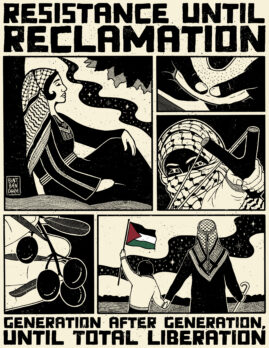
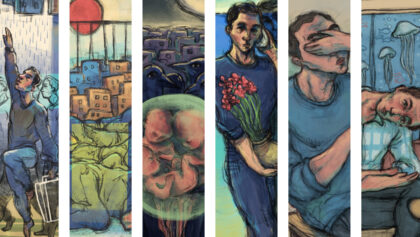
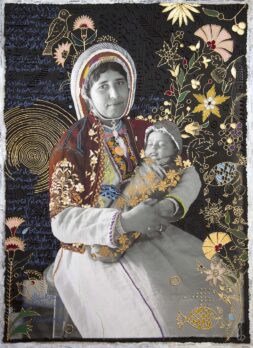
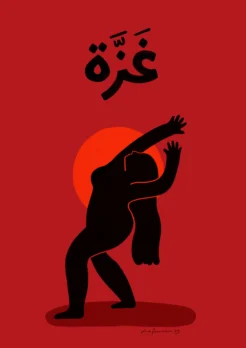
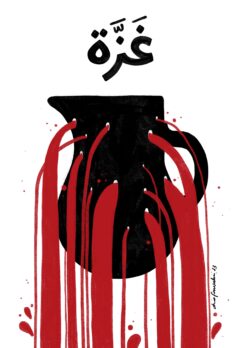
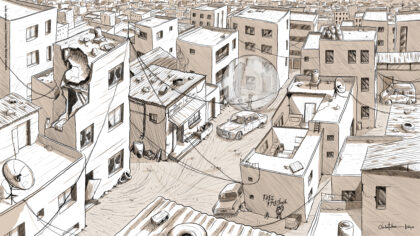
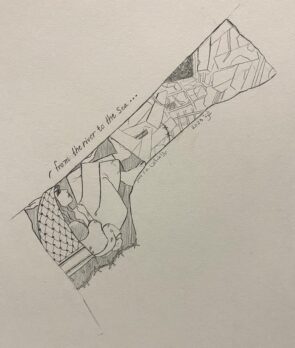
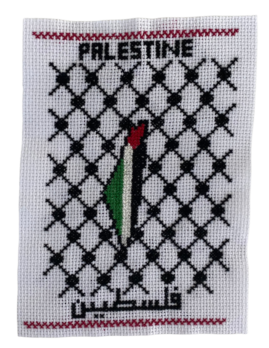
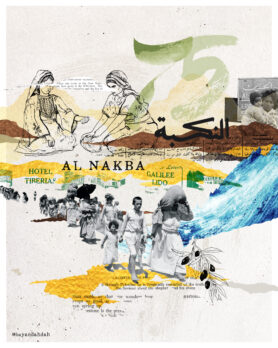
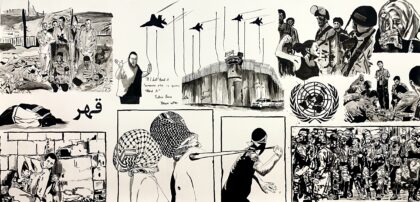
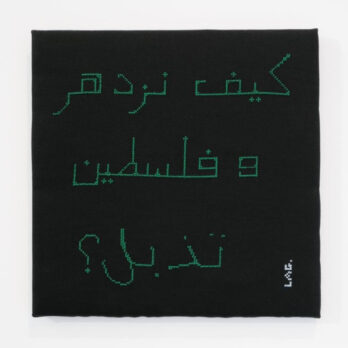
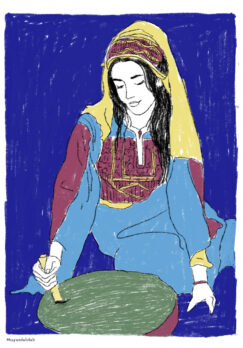
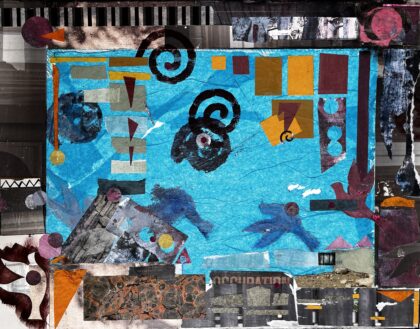
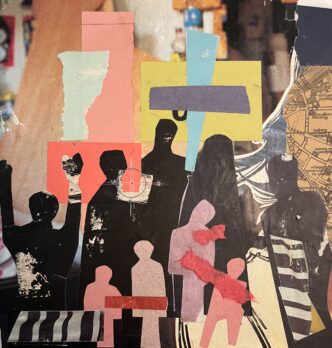
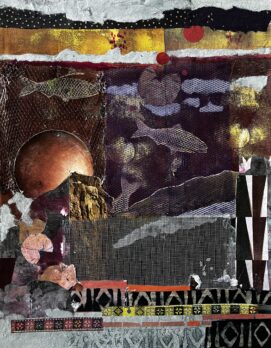
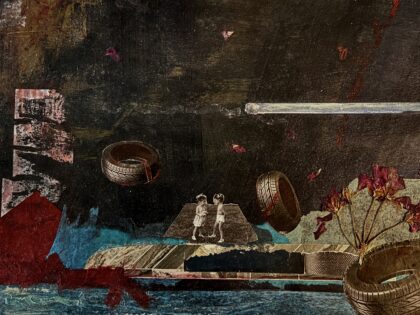
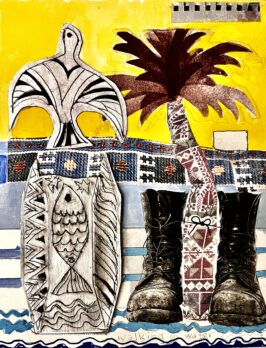
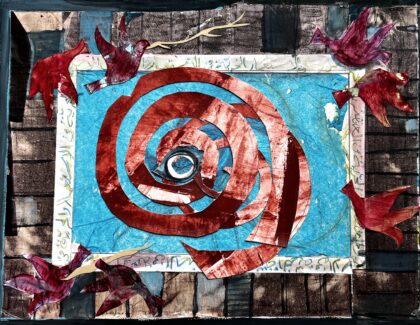
Artwork by Dina Fawakhiri
15th of October 2023
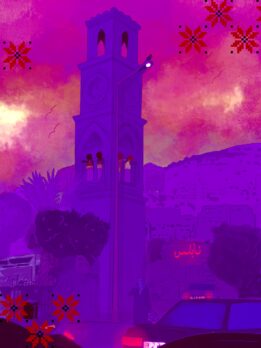
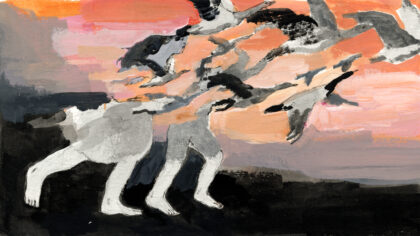
The train moves across open fields. The sky looks exceptionally picturesque today, with gradients of pink and blue. But for the first time, the beautiful sky has not managed to cheer me up. On the contrary, it has deepened my despair.
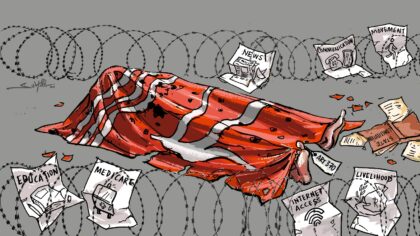
As I write these words, on a train carrying the weight of my tired body across Europe, 2,670 martyrs have fallen in Gaza, a third of whom are children. That same beautiful sky that stretches in front of me like an infinite pool of color has rained shells and bombs over the heads of Palestinians in Gaza. And like all the wars that the Israeli colonial power has ignited against innocent people in our homeland, no one seems to be angry enough to do something to stop it.
Those who care apparently do not possess enough power to do anything, and those who have the ability to do something are choosing not to.
I write in English, feeling a rising tension between myself and the language. The words feel strange, empty, unable to capture all that I am experiencing. It is not my language, and in these moments, I am searching for anything that makes me feel closer to home, closer to my people, in Palestine, and Amman, and everywhere in the Arab world. English feels cold, the words staring at me from across the screen, so rigid in their appearance, mirroring the cold that has found its way to me this morning, in France. I write in English, despite the huge distance between myself and the language, because I want those very words to travel as far as possible, to reach those who still seem to be so oblivious.
Why are our lives so cheap, so insignificant? Why are our babies less cherished and protected? Why are our children denied opportunities or a fair chance in life? Why are these babies asking too much when they demand nothing but the most basic human rights? To be known, to be named, to be seen, beyond numbers on a screen? I can’t help but ask myself: what am I even doing here? I just want to go home.
16th of October 2023
In the elevator, I greet our Moroccan neighbor and her two children. I recently moved to this building and do not know the neighbors very well. We exchange a few words as her two children stare at me closely, curiosity bubbling through their eyes. I have started to feel weird around children. I don’t want to look at their cute little faces, their littles noses and mouths and bright eyes. I don’t want to hear their giggles, nor see them talking to each other. I even feel glad to not be a mother. Mothers know what it means to lose a child, after having loved one that deeply, after having carried one inside their bodies.
I don’t want to be reminded of how small they can be, how tiny, how fragile, how innocent, and full of life. How they always look like they are deeply enjoying whatever they are doing, or they are distressed with the most trivial things. Their ability to feel things so intensely, to brighten every room they walk into, their ability to remind everyone what really matters.
Their presence only makes the reality of the murdered children in Gaza much heavier to carry and harder to accept.
I look at the two kids in the elevator and smile at them quickly before returning to my conversation with their mother. “Where are you from?” she asks me, as she examines my Palestine necklace. It is a map of Palestine that I purposefully choose to wear here; it raises eyebrows, invites smiles and also questions. “Palestine, my mom is from Palestine,” I tell her.
She starts crying and stretches her arms out to hug me.
“I am so sorry,” she says. “I am so sorry.” It feels like she is saying those words to not just me, but to the world, to all Palestinians. I am overwhelmed with her kindness. I needed that hug, as unexpected and rushed as it was. I needed to know that there were still people who cared, who saw us as humans, who were against our killing.
*
That night, my husband and I decide to watch The Battle of Algiers. We need to see the good people winning amidst the darkness of the recent events, and as an Algerian, he is happy to share his history with me. There has long been a deep and cherished connection between Palestine and Algeria, one that folds the distances between the two countries and the two people across time and space. We always thought of Algeria as our future, seeing their liberation as a promise to us, assuring us that we too will gain our freedom, even if that took 130 years of struggle and painfully resulted in the martyrdom of a million people.
Learning more about the Algerian story reminds me of what Palestinian martyr Basil al-Araj once said: “Resistance is a continuous accumulation of efforts.” Every uprising, effort, and act of resistance has an impact, one that transcends time and place. Resistance is a collective effort, made up of different acts, big and small, each leaving its mark on the long history of the people’s fight for freedom.
Later, we visit a photo exhibition about Algeria. One of the photographers asks us where we are from. “Algeria, Jordan, and Palestine,” we answer. Three countries shared between two people.
A woman rushes over to us. “I heard Palestine and I could not help but come to say Salam.” My heart bubbles with joy like a pot of stew on a stove. “For us Algerians, Palestine has a special place in our hearts,” says another photographer.
17th of October 2023
I never felt the rage like I felt last night. I didn’t know there was a point in my body that was that deep, where I could feel that much anger. The colonial killing machine has bombed Al-Ahli hospital, killing more than 1,000 Palestinians. My body shakes in disbelief. Anger is vertical, firing up from the depths of your body and bursting out through your head and ears. Sadness is horizontal, extending beyond your walls and skin, out into the world, causing your body to lose its edges. We will never forgive and we will never stop fighting. It has gotten too personal, too dark, too unbelievably evil. Don’t ask any Palestinians how they are doing, don’t give us your political analysis of what’s happening, nor your opinion. We are in deep grief and feel so let down by everyone. This all could have been stopped had the world leaders and the people been more brave in calling it what it is, a genocide, an ethnic cleansing of the Palestinian people. One that has not stopped since Al-Nakba. We are not okay, and we want nothing but justice.
18th of October 2023
As I leave my building in the morning, a woman stops cycling after seeing my kuffiyeh, and tells me we deserve peace. She sends me flying kisses, and says she wants to wear the Palestinian flag that she owns as a skirt to the market. She said she believes that can start a huge trend across the country. The interaction warms my heart, makes me feel less sad, less isolated from what is around me here, after I woke up to the news today of 3,478 martyrs in Gaza. Governments are not people, and more people than we know support Palestine in the West, more than the Zionist propaganda war machine wants us to believe.
*
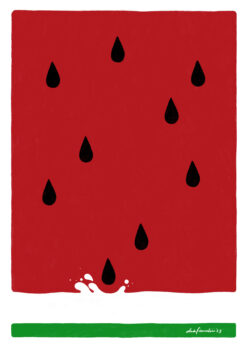
In October, the sky turned white, as Israel bombed Gaza with white phosphorus and internationally prohibited bombs. Doctors wondered, what could have possibly caused such burns? The smell of death and blood stains everything. When you hear their cries, you touch grief.
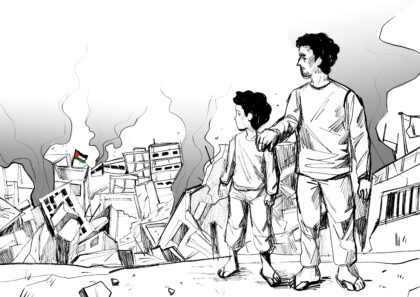
We deserve life, all of it, every bit of it, rightfully and unapologetically, with all the good things and wonders it contains. We deserve life, and our children deserve better, to play under blue skies, just like all the other children, to have friends that are not martyrs, to run in streets that are not soaked with death and blood, to go to school and grow up in a world they can feel they part of, not exiled from, to belong to a city that is not bombed so much that it has become unrecognizable to even the oldest of its inhabitants. That conviction is not an act of antisemitism.
We deserve life, we deserve better. We deserve to live independently from someone else’s history. We should not be forced to pay for crimes we did not commit, or give up our homes, or accept displacement and persecution. We have been living in struggle for more than seven decades. It has been the condition of our grandmothers and grandfathers, our mothers and fathers. It dominates our lives, and we pass it onto our children.
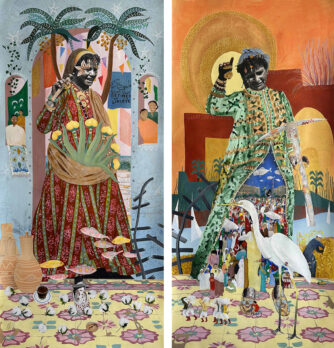
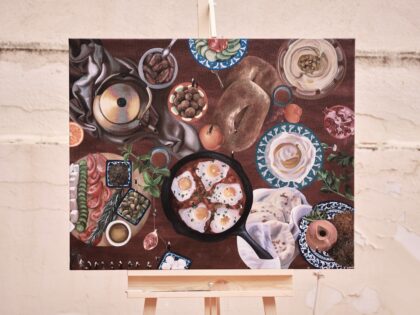
We deserve to be known outside the premises of war and occupation, through our music, food, art, and our happier days.
We are all tired, we have hardly slept in weeks, we cannot work or function outside the edges of our screens, as we frantically scroll through the news, watching videos that are too painful in acts of self-torture. Maybe that can help with the guilt, maybe this will somehow transfer some of that pain from Palestine to us, even for a little while. But the path toward liberation is long, we cannot collapse now, we need to stay strong, together. Support for Palestine is gaining momentum, growing in size, with a huge community opening its arms to everyone who stands with Palestinians rights, Palestinian lives, and for Palestianians’ unconditional freedom.
The fight goes on, and Palestine will be free.